Rising Star Now Volunteers Full-Time in Greece
February 12, 2026
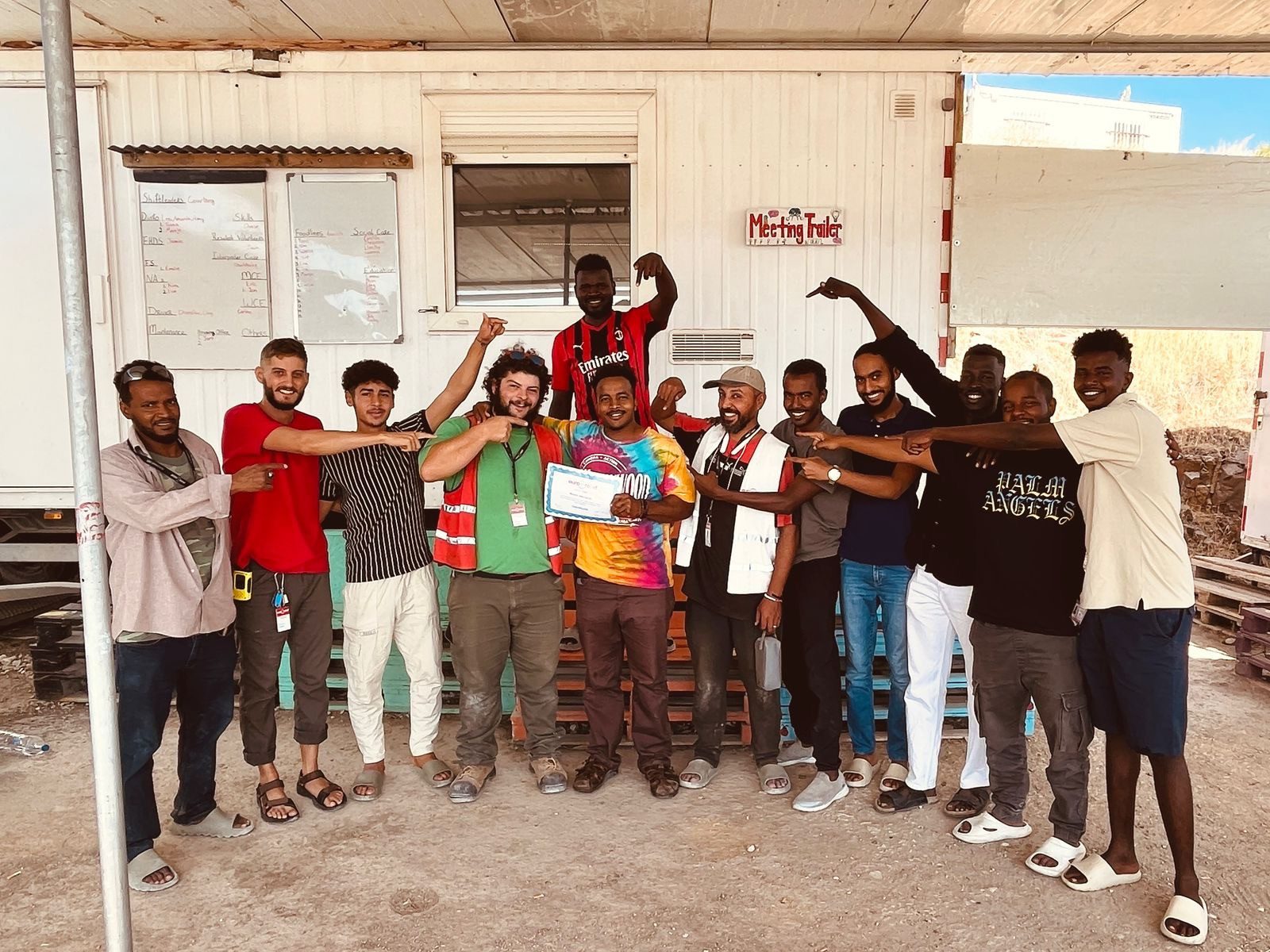
In a workshop on the Greek island of Lesbos, Three Lakes native Chase Kirby is fixing a broken water kettle. He doesn’t have the right parts – he never does – so he’s making do with what’s on hand.
Working beside him is Moho, an electrician who programmed robots in a Kia plant in Iran before fleeing civil war. Together, they’re problem-solving their way through a bin of broken appliances, because in a refugee camp of 1,500 people, a working kettle isn’t a luxury. It’s dignity.
This is a long way from the Three Lakes Fire Department, where Chase grew up helping his father, Dave – the chief – at fundraisers and community events. But in a way that makes perfect sense to anyone who knew him in high school, it’s exactly where he was always headed.
In 2016, Chase became the first recipient of the Three Lakes Community Foundation’s Rising Star Scholarship, an award recognizing volunteerism in the high school’s graduating class.
At the time, he was the kid who always said yes – to the fire department, to church youth group, to whoever showed up at school asking for help. “I’m always like, well, yeah, I’m free, I can give a hand,” he remembers now, speaking via video call from Greece.
He went on to earn a degree in mechanical engineering from UW-Stout. He came back to Three Lakes, took over Bob Hansen’s dock installation business, and planned to settle down with his wife Emma, a teacher. They wanted to raise a family there. The plan was clear. Then Emma got a phone call about teaching at a refugee camp in Greece.
At first, Emma said no. “I can’t just ask for three months off in the middle of the school year,” she told Chase.
But he knew her well enough to recognize the longing underneath. “The worst they can tell you is no,” he said. “It’s something you’ve always been interested in.”
Her administration surprised them both. “That sounds like a really good opportunity,” they said. “You should do it.”
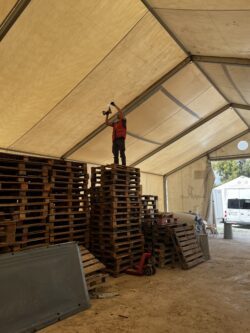
So in January 2024, Chase and Emma went to Greece for three months. Emma taught. Chase joined the maintenance team, building housing units – plastic shelters from IKEA that volunteers assemble, install floors in, and prepare for families who have crossed the Aegean Sea from Turkey in rubber rafts, sometimes in storms, sometimes with fatal consequences.
When they came back to Wisconsin, people asked how it was.
“If we didn’t have actual adult jobs,” Chase and Emma kept saying, “we would have just stayed.”
They said it so many times that eventually Chase thought, “Maybe God’s telling us we’re supposed to be somewhere else.”
They looked at other missionary organizations. They considered other options. But Greece kept pulling them back – which made them hesitate, because “it was too comfortable and easy,” Chase says now. “Like, we know what we’re getting into. It doesn’t make sense that that’s where we should end up.”
Looking back, he laughs at the logic. “Yeah, of course, that’s where we should be.”
When they reached out to Euro Relief – the Greek nonprofit, faith-based organization running programs in the camps – the response was immediate: “You guys aren’t already planning on coming back? We’ve been waiting for you to tell us when you’re coming.”
In August 2024, they moved to Lesbos. Their initial commitment: three years.
CHASE’S DUTIES
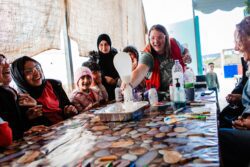
Chase coordinates the skills area and maintenance team at Mavrouni camp (the name means “Black Mountain”). The work is practical, immediate, and endlessly improvised. The skills workshop is open three days a week, offering residents access to a gym, a bike repair shop, and a woodworking area with tools for fixing broken items.
“A lot of times with bike repairs, we end up making what we have work,” Chase explains. “It took me a while to get used to – okay, this isn’t a great solution, but it works, and they can ride their bike out of here.”
The residents who volunteer alongside him aren’t unskilled people waiting to be helped. They’re teachers, doctors, lawyers, electricians – people fleeing war and persecution from the Middle East, Northern Africa, and beyond. Moho, the Iranian electrician, knows his way around tools better than most. Another former resident volunteer was “really good at welding and metal fabricating,” Chase says. “We made some gym equipment with his skills.”
The camp population fluctuates dramatically. When Chase and Emma first arrived in early 2024, there were 5,000 people in Mavrouni, but that number changes often due to the political situation in Greece.
Those who make it to Greek soil can begin the asylum process, proving their lives would be in danger if they returned home. For some – Syrians, Afghans – the process moves quickly. For others, like the man from Somalia Chase met in January 2024 and found still waiting in August, rejection after rejection, the camp becomes home for months or years.
Seven days a week, Euro Relief volunteers show up. Weekdays from 8:30 am until evening. Weekends for two-hour food distribution shifts. Emma works with the education team – story time in the library, outreach programs for kids between their shifts at Greek public schools. Chase fixes bikes and kettles and whatever else breaks.
They live in an apartment with what they call their “Greek grandma and grandpa” – landlords with six dogs and chickens running around. They raise financial support through their church, family, and friends to cover their monthly budget.
They volunteer. (In camp, there’s a distinction: they don’t *work* there. They volunteer. Even though it’s what they do every day.)
WHAT IT MEANS
“There’s a lot of things in the world that just wouldn’t happen if volunteers weren’t there,” Chase says. He’s seen the difference between camps where Euro Relief has a presence and camps where it doesn’t.
He’s also seen the pattern that follows him from Three Lakes: “The 20% of people who do 80% of the work.” The same dedicated few, showing up again and again. “It’s amazing to see those people so dedicated to their community,” he says. Now he’s one of them – just in a different community, 5,000 miles from home.
When asked what he’d say to a young person who doesn’t see the need for volunteering, Chase’s answer is practical: “Just take advantage of it. You’ll never regret going and doing something like this. Experience a different culture. See what’s out there.”
He and Emma have committed to three years. But if you ask them now, nine months in, they’ll tell you the same thing they said after their first three months: if they didn’t have actual adult jobs waiting back home, they’d just stay.
The Three Lakes Community Foundation’s Rising Star Scholarship opens for applications on February 13. Chase Kirby was the first recipient in 2016. Nine years later, he’s proof of what volunteerism can become when you keep saying yes – when you’re always like, “Well, yeah, I’m free. I can give a hand.”
Even when “a hand” means crossing an ocean to fix water kettles in a refugee camp with an Iranian robotics programmer, building housing for people who crossed the sea in storms, being present seven days a week for people whose asylum cases have been rejected seven times.
That’s what the scholarship set in motion.
That’s what it looks like when the Rising Star keeps rising.